
Xanadu
In daily useThe autonomous development loop behind the projects on this page.
Jose Antonio Licon · Pittsburgh, PA
I build apps, games, and platforms — powered by an AI development system I built myself. Product manager and engineer, open to consulting.
Not “Antonio uses AI to help him code” — an unattended system that plans the work, writes the code, tests it, and fixes its own mistakes, then brings back only the decisions that need a human.
Most people describing AI-assisted development mean Copilot or Cursor: a smarter autocomplete with someone at the keyboard. This is categorically different. Nobody is at the keyboard.
The apps below aren't just products. They're the benchmarks.
That's Xanadu. How it works →
The autonomous development loop behind the projects on this page.
Merge fleets. Take the galaxy. Minimalist real-time strategy with no ads and no in-app purchases.
Your personal life organizer — sprints, a roadmap, and a magic hat full of ready-made tasks, with everything automatically ordered by priority.
Internet radio with a classic car preset interface. Old-school vibes, a world of streaming.
Community-driven platform for activism and resource sharing in Pittsburgh.
A turn-based tactical hex board game where gem "bricks" capture tiles and merge upward in grade.
A local dashboard for everything I'm building: status, activity, roadmap progress, and who (or what) did the work.
The engine
An autonomous development loopthat compresses two weeks of work into two days of wall-clock time. Here's how it works.

Tasks completed autonomously
1,200+
First-pass success rate
70%
Commits in the last 30 days
581
From the task logs and git history across 21 of the last 30 days; updated 2026-09-27.
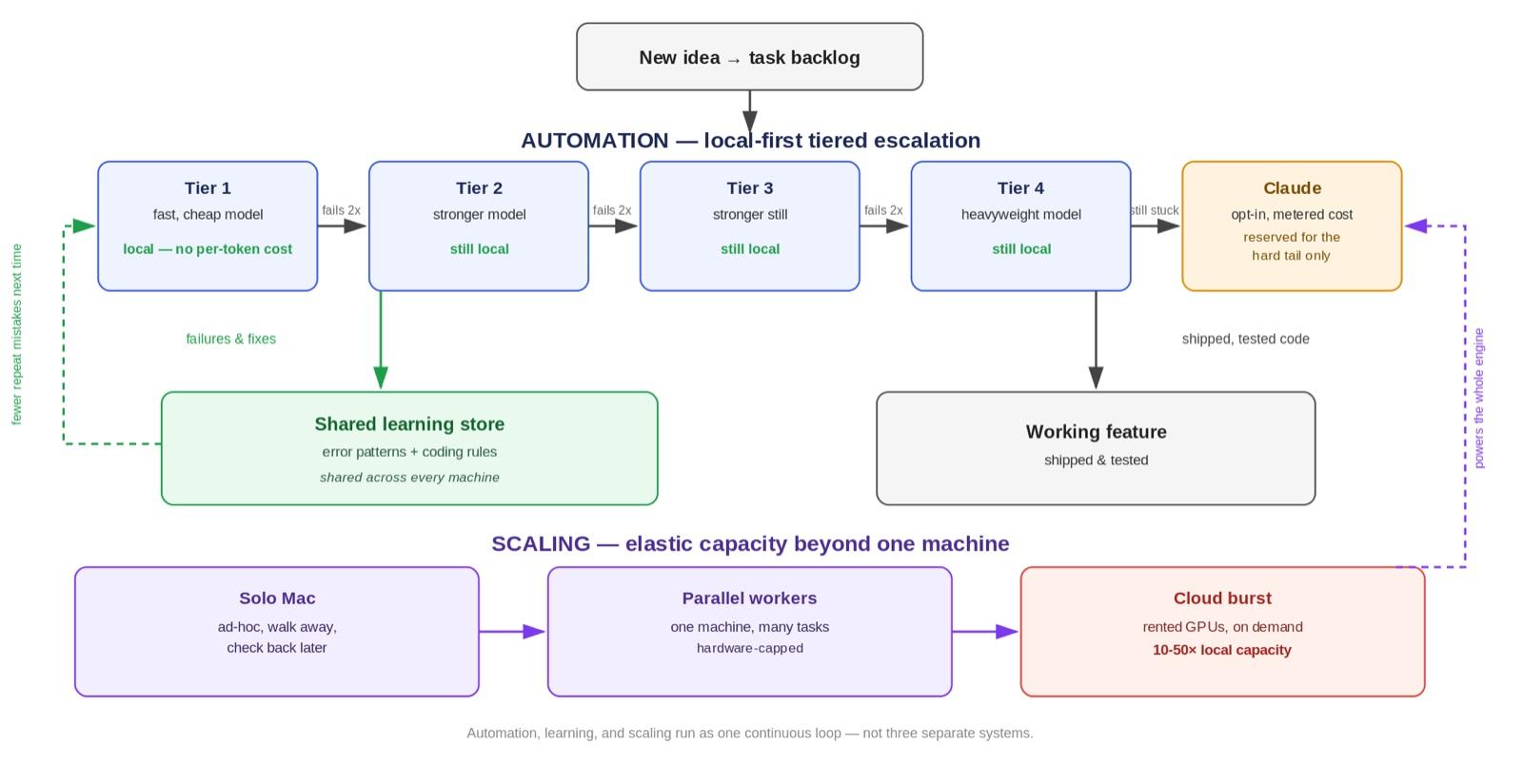
A planner turns a roadmap into small, testable tasks. An executor writes each change. A validator runs static analysis and the task’s own tests — nothing counts as done until they pass. Failures are classified, fed back into the next attempt, and escalated if they keep coming. All state lives in the roadmap and git, so a run survives being stopped and picks up where it left off.
Every task starts on open models, on hardware I control. Day to day, that’s a Mac running a 27B coding model through Apple’s MLX — and in practice it handles nearly everything. For big sprints it scales out to RunPod: one rented GPU or many, each running agents in parallel, with headroom for larger models if a job ever calls for them; most of Galaxican’s 600+ tasks ran that way. Claude sits at the top, reached only when a task has beaten every open-model tier, so frontier compute goes to the problems that genuinely need it. Gemini is the outside voice: I consult it for creative work and as a sanity check on what the loop produces.
Every rung of the ladder is a setting, not a rewrite. Each tier names a model, and swapping one in — a newer release, a bigger dense model, a small fast one, a coding specialist — is a config change. When a better open model ships, Xanadu gets better the same day.
A BAD_PATTERNS immune system blocks mistakes it has already seen. A rule-promotion loop turns repeated fixes into permanent rules shared across every machine. And a velocity log of every task shapes what gets planned next.
ProjectsDash
I woke up with the idea, had a quick chat with Claude to shape a roadmap, and pointed Xanadu at it. On a single Mac, with a local model and no cloud bill, it worked through the roadmap largely unattended. Then I polished the rough edges with Claude.
Galaxican
Galaxican is where Xanadu was proven and hardened. For its biggest push, the same loop scaled out to parallel workers on a rented GPU — capacity that costs a few dollars an hour — and the game shipped to both app stores.
Want a loop like this for your team or your product? Get more from AI →
I started where everyone starts — Claude, Gemini, the usual suspects. I was amazed at what was possible. Then I ran out of tokens.
Most people slow down at that point. I bought a maxed-out MacBook Air and started learning local LLMs instead.
What began as a workaround turned into something more interesting: a complete development loop. Product ideation. SWOT analysis. Backlog generation. Code execution across parallel workers. Models that fail over to more capable tierswhen a task is too hard. Error patterns that get learned and encoded so they don't burn retries twice.
Now I set it running overnight. By morning, the project is mostly done. When I need more firepower, I spin up RunPodand the backlog burns down in parallel, at a cost that doesn't require a VC.
It didn't replace the craft — my background as a full-stack developer and technical product manager is what makes the system work, not what it replaced. I still drive. I still take the wheel when the models hit a wall, or the project needs a pivot. Agile methodology is the backbone of the whole system — not just a buzzword, but the actual structure that keeps every project on this page moving at once.
This isn't a silver bullet. It's a superpower.
Product manager and engineer — I write the roadmap, and I build the thing it describes.
Before Xanadu, I spent my career on both sides of the product line: as a product owner and manager setting direction, and as the web and mobile developer shipping the code. That work spans podcasting, public media, higher education, 3D software and games — including live-audio apps and Alexa skills for Pittsburgh public radio.
Xanadu is what happens when those two jobs meet: agile product discipline, encoded into a system that does the building.
Product and technical leadership roles with
Want that on your team? Get more from AI →
Consulting
I turn product people into builders, and help dev teams ship more — and better — with AI. ProjectsDash started as an idea one morning — and was working software three days later.
I spend most of my time building and traveling, so I'm not looking for a full-time role. I take on a few focused engagements at a time.
For product leaders
For technical PMs, product leads, and founders. I help you set up a local-first development loop and learn the workflow I use: shape a roadmap with a frontier model, hand the bulk of the build to an autonomous loop, then polish with an agentic assistant. You stop waiting on a queue and start shipping your own ideas.
For dev teams
For engineering leaders. We baseline one team’s cycle time, throughput, and escaped defects, set up the loop on your real backlog — with tests as the gate for “done” — and compare after about six weeks, with a first read at two. You keep the setup and the numbers either way.
For existing codebases
Clean up, extend, port, or re-architect an existing codebase — splitting out services where it actually pays, not because it’s fashionable. We start with an assessment and a test safety net that pins down what the code does today, then the loop modernizes it in small, tested steps, and your code stays on hardware you control. Proven in Dart, TypeScript, Python, and Go; older languages welcome, COBOL included. If yours is new to the system, I’ll prove it out on a small project first, on me.
A side effect: most of the work runs on open models on hardware you control, so your AI bill grows far more slowly as you add developers.
What happens after you hire me, step by step: how I build software →

